


As an Amazon Associate, we earn from qualifying purchases. We may also earn a commission from other retailers linked on this page, at no extra cost to you.
Choosing a Cartier Tank starts with recognizing that “Tank” describes a family, not a single watch. Its defining language is the pair of parallel brancards, with the case integrated into the extension of the bracelet or strap rather than visually separated from it. Designed by Louis Cartier in 1917, the Tank has since received multiple interpretations while retaining its essential identity.
This Cartier Tank buying guide will help you decide which direction makes sense: the classic Louis Cartier character, the elongated and curved proportions of the Cintrée or Américaine, the bracelet-led style of the Française, or the more accessible construction of the Must. The right choice depends on case dimensions and wrist fit, movement type, material, water resistance, service considerations, collectibility, and the wardrobe the watch needs to join—not on one model being universally best.
Quick answer: Which Cartier Tank suits you?
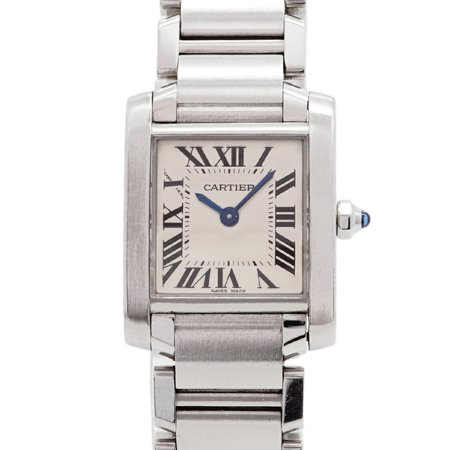
For the most traditional expression, start with the Tank Louis Cartier, a named model within the collection—then separate current references from historical variants before comparing examples.
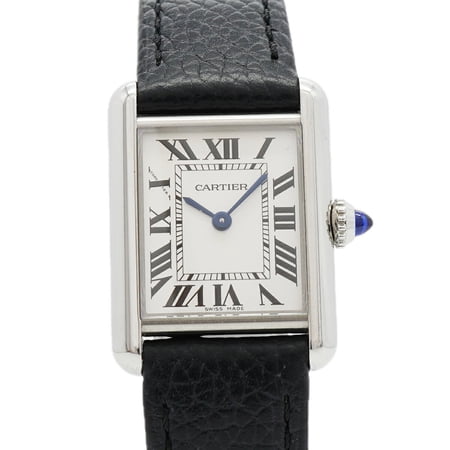
- Accessible and technology-focused: choose the Tank Must. Quartz is common, while Solarbeat offers light-powered quartz; construction and movement trade-offs deserve closer comparison later.
- Curved case: consider the Cintrée, with its manual-winding mechanical caliber 1917 MC, or the Americaine, its modern elongated counterpart.
- Metal bracelet: the Française is the clear route and the only Tank offered exclusively on one.
- Rarity or technical interest: investigate Privé and skeletonized models.
Your final choice should follow wrist dimensions, preferred material, movement expectations, and budget—not brand recognition alone.
What matters most when buying a Cartier Tank

Start with the design language. The Tank’s defining feature is its two parallel brancards, the rails that give the case its architectural outline and visually continue into the bracelet or strap. Cartier describes the design as inspired by a military tank viewed from above, with the brancards representing its tracks. Roman numerals, a rectangular or square dial, sword-shaped hands, and a crown topped by a sapphire or, in some versions, ruby cabochon are recurring cues to assess when comparing references. The details still matter: the Tank Cintrée, for example, pairs gray Roman numerals with blue, apple-shaped hands and a sapphire-set gold crown.
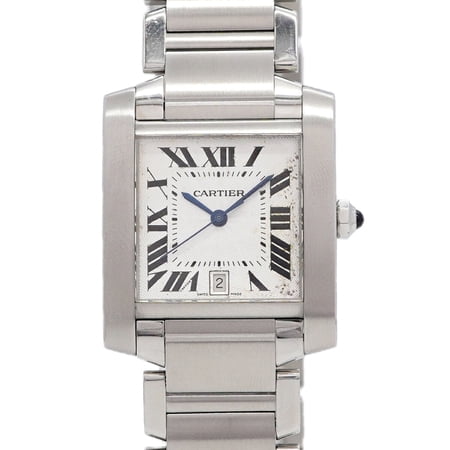
Fit requires more than comparing a single diameter. On a rectangular watch, length, width, and the visual presence of the lugs or brancards determine how much wrist area the watch occupies. The traditional Tank profile is comparatively flat, while the Cintrée uses a gently curved case intended to follow the wrist more closely. A documented Cintrée measures 23 by 46.3 mm and is 6.95 mm thick, proportions that illustrate why a long, narrow watch can wear very differently from a round watch with a similar nominal width. Consider the case’s end-to-end presence, not just its width.
Movement choice separates the ownership experience. Quartz favors straightforward timekeeping, while the SolarBeat approach uses a quartz movement charged by sunlight. Manual-winding mechanical Tanks make winding part of the daily ritual: the Cintrée uses Cartier’s caliber 1917 MC, a hand-wound manufacture movement. The openworked Cintrée uses hand-wound caliber 9917 MC, making the movement itself central to the watch’s character. Automatic options also exist in the Tank family; Cartier’s Tank MC collection was introduced with in-house automatic movements.
Materials and dial execution should be judged together. Solid gold changes the watch’s weight and precious-metal presence; gold vermeil, stainless steel, and platinum should be verified on the exact reference rather than inferred from photographs or collection names. Openworking offers a more overtly mechanical display, while a conventional Roman-numeral dial preserves greater visual restraint. The Cintrée example uses an 18K yellow-gold case and a golden-finish opaline dial.
Finally, verify ownership details before buying. The Cintrée is rated to 3 bar, approximately 30 meters, but that rating should not be generalized across every Tank model. Cartier Care states that registration extends the Cartier International Warranty to eight years; confirm eligibility and terms for the specific watch.
Budget, size, and style: matching the Tank to the buyer

Budget, size, and style: matching the Tank to the buyer
Think of the collection as a ladder of priorities rather than a simple price scale. The Tank Must is the most accessible Tank, and it is the only version offered with Cartier’s light-powered Solarbeat quartz movement. Gold-colored Must models are gold vermeil, while traditional gold Tanks use solid 14k or 18k gold. At the other end of the collecting spectrum, Privé examples such as the Normale and Cintrée carry greater historical and material significance: the Normale has appeared intermittently since 1919 in gold or platinum, while the Cintrée was the first major reinterpretation of the original Tank in 1921. A skeletonized example should be evaluated as a higher-complexity purchase, with movement architecture and service support receiving as much attention as the case material.
For a smaller wrist, case length, width, thickness, and curvature matter more than a label such as “small” or “large.” The Cintrée illustrates the point: its documented dimensions are 23 x 46.3 mm, with a thickness of 6.95 mm. Its elongated, curved gold or platinum case is designed to follow the wrist. That combination can remain slim while still creating substantial visual length, so compare lug-to-lug behavior and photographs on the wrist before buying.
On a larger wrist, the Américaine’s elongated, curved case can provide more presence than a compact classic Tank; the model was introduced in 1989 as a modernized Cintrée and is offered across sizes, movements, and metals. The Française makes a different statement through its square dial and chunkier brancards, and it is the only Tank exclusively available on a metal bracelet. Check the exact dimensions of the reference rather than relying on the family name.
Strap-led Tanks generally suit a more formal, dress-watch wardrobe, while the Française’s bracelet gives it a more integrated everyday identity. The Must is the broader access point. Choose quartz or Solarbeat when low-maintenance ownership matters; choose a manual-winding example when daily interaction and traditional mechanical construction matter. Many Musts use quartz, while some use simpler hand-wound movements. For pre-owned or vintage pieces, verify the originality of the dial, crown, hands, case, and movement, then review service history and provenance. Age alone is not proof of collectibility.
Cartier Tank models compared

The Tank name covers several distinct design and movement choices. This comparison separates established families from specialized historical branches, which should not automatically be treated as current retail options.
| Model or family | Case and style identity | Movement or technology | Material or wearing format | Best fit |
|---|---|---|---|---|
| Tank Louis Cartier | The named classic family within the Tank collection. | Not confirmed here | Not confirmed here | Buyers prioritizing the most traditional Cartier Tank expression. |
| Tank Normale | The historically original-form approach; produced on and off since 1919. | Not confirmed here | Gold or platinum; associated with Cartier Privé. | Collectors seeking the Tank’s early architectural language and Privé context. |
| Tank Cintrée | Elongated, curved case designed to follow the wrist. | Manual-winding manufacture caliber 1917 MC; 23 x 46.3 mm and 6.95 mm thick. | Documented example in 18K yellow gold on an alligator strap. | Mechanical-watch buyers who prefer a long, refined profile. |
| Tank Américaine | Modernized, curved interpretation of the Cintrée, introduced in 1989. | Multiple movements and sizes are documented. | Available across multiple metals and sizes, according to the cited source. | Buyers wanting a curved Tank with broader configuration choices. |
| Tank Française | Square dial and chunkier brancards. | Not confirmed here | Exclusively offered on a metal bracelet. | Those who want a more substantial, bracelet-led everyday format. |
| Tank Must | The most accessible Tank family. | Quartz, hand-wound, and light-powered Solarbeat quartz distinctions are documented. | Gold-colored examples may be gold vermeil rather than solid gold. | First-time buyers and gift shoppers comparing lower-complexity ownership options. |
| Tank MC | A distinct modern mechanical branch. | Introduced in 2013 with 100% in-house automatic movements. | Not confirmed here | Buyers specifically seeking an automatic, in-house Cartier movement. |
Collector branches: Skeletonized and Privé pieces require separate research. The openworked Cintrée uses hand-wound caliber 9917 MC. Historical complications include the Monopoussoir, à Guichets, Basculante, and Asymétrique; these are specialized or historical examples, not a shorthand for standard current availability.
Pros and cons of each Cartier Tank approach

The right Cartier Tank depends less on prestige than on how much heritage, flexibility, and mechanical complexity you actually want.
Strengths
- Louis Cartier or Normale: The most historically continuous, restrained dress-watch choice. The Louis Cartier traces its design to 1917, while the Normale has been produced on and off since 1919.
- Cintrée or Américaine: Curved cases create distinctive wrist presence; the Américaine, introduced in 1989, modernized the Cintrée’s elongated profile.
- Française: The integrated metal-bracelet appearance gives the watch a clear, jewelry-like presence. It is the only Tank model documented as exclusively available on a metal bracelet.
- Must: The most accessible route into the collection, with quartz options and the light-powered Solarbeat movement.
- Skeleton, Privé, or historical complications: Rarity and technical interest can make these compelling collector pieces; the openworked Cintrée, for example, uses a hand-wound caliber 9917 MC.
Trade-offs
- Classic examples offer less casual flexibility and depend heavily on material, condition, and provenance.
- Curved, elongated cases may overwhelm smaller wrists and bring more specialized case or movement considerations.
- The Française offers less strap versatility.
- Gold-colored Must models use gold vermeil, not traditional solid gold, and many variants use less elaborate movements.
- Rare complications demand specialist sourcing, authentication, and servicing. Rarity alone does not guarantee value retention.
Recommended Cartier Tank watches

This section does not contain named product recommendations. No affiliate products are available in the supplied product database, so the most useful approach is a buyer’s shortlist rather than a list of watches to purchase. That distinction matters with Cartier: Tank is a collection with multiple interpretations, not one uniform specification.
Before assessing an individual listing, record the criteria that actually determine whether it fits. Start with the desired Tank family, then define the preferred case dimensions, movement type, case material, and stated water resistance. Add the practical ownership questions: whether the watch is covered by a current warranty, what service documentation accompanies it, and whether its provenance is clear.
- Family: Decide whether the design direction and visual character of the particular Tank family match the intended use.
- Dimensions: Compare the listed measurements with the buyer’s preferred proportions, rather than relying on descriptions such as small, medium, or large.
- Movement: Establish whether the watch uses a quartz, automatic, or manual-winding movement, and consider how that choice affects maintenance and ownership.
- Material and water resistance: Confirm the case material and the manufacturer’s stated rating in the exact reference.
- Warranty and provenance: Separate an active warranty from an expired one, and request records that clarify origin, servicing, and any replaced components.
That process is more reliable than applying a model family’s reputation to every example. Cartier identifies the Tank’s signature as its two parallel brancards, but the condition, originality, and paperwork of an individual watch still determine its collecting value and ownership risk. Compare the exact reference and condition, including dial, hands, case, bracelet or strap, and movement, before treating any listing as a serious candidate for this cartier tank buying guide.


Prices and availability are accurate as of the date/time indicated and are subject to change.
Frequently asked questions
What are the main Cartier Tank models, and how do they differ?
Tank is a family defined by two parallel brancards, rather than one case design. Tank Louis Cartier is the traditional named model. Tank Cintrée uses an elongated, curved case, while Tank Américaine is a modernized, similarly elongated interpretation introduced in 1989. Tank Française has a squarer dial, broader brancards, and is offered exclusively on a metal bracelet. Tank Must is the more accessible branch. Privé covers specialized historical designs such as the Normale and Cintrée.
Which Cartier Tank models suit small or large wrists?
Case dimensions and curvature matter more than the Tank name alone. A compact, flat Louis Cartier or Must can suit a smaller wrist, but buyers should compare the exact reference’s dimensions rather than assume every model wears alike. The Cintrée measures 23 x 46.3 mm and curves toward the wrist, making its elongated profile a deliberate choice for larger wrists or buyers who want visible length. Compare case length, width, thickness, and strap or bracelet adjustment before buying.
Do Cartier Tank watches use mechanical or quartz movements, and which models have in-house movements?
The answer varies by model and reference. Many Tank Must watches use quartz, while some use hand-wound mechanical movements. The Tank Cintrée cited by Cartier has a manufacture manual-winding caliber 1917 MC. Cartier’s Tank MC collection, introduced in 2013, used 100% in-house automatic movements. The openworked Cintrée Skeleton uses hand-wound caliber 9917 MC. Check the exact reference because movement type is not consistent across the Tank family.
How do materials affect a Cartier Tank’s price and collectibility?
Material changes both the ownership proposition and the market context. Gold-colored Tank Must models are gold vermeil, while traditional gold Tanks are made from solid 14K or 18K gold. That distinction should be confirmed in the specifications and reflected in comparisons between examples. Collectibility also depends on the model, movement, condition, provenance, and production history; material alone does not establish value. For a vintage watch, verify the case material, originality, and service history.
Are there accessible Cartier Tank models with solar or quartz technology?
Tank Must is generally the most accessible entry to the family and the only Tank branch identified with Cartier’s light-powered SolarBeat quartz movement. Many other Tank Must watches use conventional quartz, while some use hand-wound movements. Solar and quartz options prioritize straightforward ownership and reduced winding over mechanical involvement. Confirm the exact reference, because Tank Must construction and movement choices vary across the collection.
Which Cartier Tank models are most collectible, and what should buyers know about service and warranty?
Specialized Privé and skeletonized Tanks tend to attract collectors because of their unusual designs and mechanical interest. Examples include the Tank Normale, Cintrée, the Noctambule skeleton, and the Cintrée Skeleton; the Noctambule appeared in 2004, while the Cintrée Skeleton uses caliber 9917 MC. Buyers should inspect originality, condition, movement, and provenance. Cartier Care can extend the Cartier International Warranty to 8 years; confirm eligibility and current terms with Cartier.
Final advice: Buy the Tank that fits your priorities

Use this Cartier Tank buying guide as a decision path. Start with the silhouette: do you want a flat classic, a curved case, a bracelet-led design, or an experimental interpretation? Then choose movement behavior: quartz or light-powered Solarbeat offers convenience, while manual-winding or automatic mechanics invite more involvement.
Before comparing listings, confirm the exact case dimensions, material, water resistance, service history, warranty documentation, and the originality of visible and mechanical components. Treat collectibility and value retention as results of specific attributes and credible provenance—not guarantees attached to the Cartier name. For a first purchase, favor the Tank whose proportions and ownership requirements you understand clearly, rather than the most complicated or rare example. Cartier Care can extend the Cartier International Warranty to eight years when registered.


.jpg)