

As an Amazon Associate, we earn from qualifying purchases. We may also earn a commission from other retailers linked on this page, at no extra cost to you.
The choice between Cartier’s Santos and Tank is best decided by use and character: choose the Santos for a more casual, bracelet-led direction and Cartier’s sportier, edgier executions; choose a Tank if you prefer a more formal rectangular design. The second answer must remain qualified, because “Tank” covers several families and sizes. Before comparing dimensions, movements or current prices, confirm whether the intended watch is a Tank Must, Tank Française, Tank Louis or another configuration.
The Santos also brings a particularly direct aviation connection. In 1904, Louis Cartier made a watch for Alberto Santos-Dumont so he could read the time without removing his hands from the controls. Cartier put a refined square Santos into production around 1911, and the design later received its distinctive bracelet in 1978. That gives the Santos a clear, evolving production history—not an interchangeable historical counterpart to every Tank. The available research supports a detailed Santos analysis; Tank-specific specifications and prices require model-level verification before publication.
The short answer: Choose the Santos for versatility, the Tank for formality
In the Cartier Santos vs Tank decision, choose the Santos if you want a square watch with a sportier Cartier character, an integrated-looking bracelet, and the flexibility of Cartier’s Quickswitch interchangeable strap system. It is also the more straightforward choice for collectors who value everyday adaptability: the medium measures 35.1 × 41.9mm, while the large measures 39.8 × 47.5mm. The large titanium version can wear smaller than its polished steel counterpart because of its lighter, matte construction.
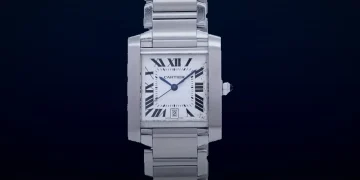
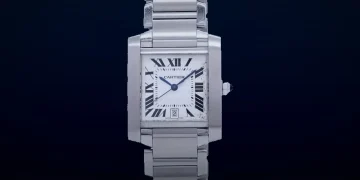
Choose the Tank if your priority is a classic rectangular dress-watch profile and a more formal presence. The right recommendation then depends on the Tank family and size, since “Tank” covers several distinct designs. Collectors who want the Santos’s standard technical profile should note that medium and large models use Cartier’s 1847 MC automatic movement, while skeleton versions use the 9619 MC instead.
Specifications compared: What the available evidence confirms
For a fact-checked Cartier Santos vs Tank comparison, the available evidence is substantially stronger for the Santos. The following framework separates documented specifications from Tank details that are not verified in the supplied sources.
| Category | Santos | Tank |
|---|---|---|
| Dimensions | Medium: 35.1 × 41.9 mm; large: 39.8 × 47.5 mm. | Not verified in supplied sources. |
| Thickness | 8.83 mm. | Not verified in supplied sources. |
| Date | Medium: no date; large: date window at six o’clock. | Not verified in supplied sources. |
| Movement | Caliber 1847 MC automatic; skeleton versions use caliber 9619 MC. | Not verified in supplied sources. |
| Bracelet systems | QuickSwitch allows bracelet or strap changes; SmartLink enables partial link removal. | Not verified in supplied sources. |
| Documented prices | 2018 figures: $6,250 for a medium steel model with bracelet and strap; $9,100 for a medium two-tone model; $37,000 for a large rose-gold model. | Not verified in supplied sources. |
The movement distinction matters to collectors: the 1847 MC is the standard documented Santos caliber, while the 9619 MC belongs to the skeletonized executions. The 1847 MC is reported with 23 jewels, a 4 Hz frequency and a 42-hour power reserve.
Material choice also changes the wearing proposition. A 2025 Santos variant is described as having a full titanium case and bracelet, with a matte, lightweight character that can make the large model feel smaller than polished steel. The other documented variant uses polished stainless steel with a black dial and more lume: its hands, indices and minutes track are lumed, while the titanium dial has no lume. The titanium bracelet does not have SmartLink adjustment, although the bracelet system includes QuickSwitch.
The 2018 Santos prices are stale historical figures, not current buying guidance. The 2025 WatchTime source reports pricing and availability for the newer steel and titanium models, but the supplied fact bank does not preserve a usable verified figure.
Design and wearability: Square sportiness versus rectangular restraint
The Santos’s square case gives it a more assertive presence than Cartier’s restrained rectangular Tank silhouette. Its exposed screws reinforce that impression, while the contrast between matte surfaces, polished bevels, and polished screws keeps the design from becoming purely utilitarian. Cartier positions the Santos as the sportier, edgier part of its collection, including brushed-metal and all-black executions. A Santos case and bracelet can also be made from solid stainless steel with matching steel screws.
Finishing and dial treatment materially affect how the watch reads. A steel Santos variant uses lume on the hands, indices, and minute track, while the titanium version described by WatchTime has no lume. The large titanium Santos is particularly worth considering if a conventional large steel watch sounds visually or physically imposing: its matte, lightweight case reportedly wears smaller than the shinier steel versions. That makes case proportion more useful than gender labels when judging fit. The medium measures 35.1mm by 41.9mm, while the large measures 39.8mm by 47.5mm.
Practicality is another Santos advantage. Cartier’s QuickSwitch system lets the wearer remove the bracelet or strap by pressing a tab between the lugs and sliding the band away. SmartLink allows bracelet links to be removed with a button-operated pin system, but the titanium bracelet is an important exception: it does not have SmartLink. Check that detail before choosing titanium if precise at-home sizing matters.
In the cartier santos vs tank decision, the Santos is the more natural choice for casual, business-casual, and bracelet-led wear. A Tank can make the more formal statement, but that conclusion depends on the particular Tank’s case, dial, and strap configuration rather than the collection name alone.
Movement and performance: 1847 MC practicality versus 9619 MC openness
The standard medium and large Santos models use Cartier’s 1847 MC automatic movement. It has 23 jewels, beats at 4 Hz, and provides a 42-hour power reserve. In practical terms, this is a conventional self-winding profile: the watch offers a defined reserve rather than an unusually long one, while the 4 Hz frequency reflects a modern high-beat operating rate without, by itself, guaranteeing greater real-world accuracy.
The 1847 MC also uses nickel-phosphorous components for increased resistance to magnetism and is covered by a paramagnetic alloy inside the case. That construction is relevant for an everyday watch exposed to electronic devices and other magnetic sources, although it should be understood as a resistance measure rather than a reason to treat the Santos as immune to magnetism.
A skeleton Santos is not simply the same watch with part of the dial removed. The skeletonized versions use Cartier’s 9619 MC movement instead of the 1847 MC. This makes the openworked model a materially different technical and visual proposition: the movement architecture becomes part of the display, and the choice involves a different caliber as well as a more demonstrative presentation.
The movement side of a cartier santos vs tank comparison therefore needs some discipline. The supplied research does not establish enough Tank movement evidence to specify a fair caliber-to-caliber comparison. Verify the exact Tank reference and its caliber before drawing conclusions about winding system, power reserve, beat rate, or anti-magnetic construction. More broadly, case style and movement architecture are separate questions: choosing the Santos or Tank does not identify one universal caliber across every family or configuration.
Value, ownership, and servicing: What to verify before buying
Historical pricing is useful only as context, not as a current buying guide. In 2018, the medium stainless-steel Santos with bracelet and strap was listed at $6,250, the medium two-tone version at $9,100, and the large 18k rose-gold model at $37,000. Current Santos-versus-Tank pricing, pre-owned values, resale retention, and service costs are not established by the supplied evidence, so verify them through current, model-specific research.
Configuration matters more than the collection name suggests. Case material, size, bracelet or strap, and skeleton construction can change the entry price and may affect servicing complexity. Treat each exact reference as a separate ownership proposition rather than assuming that a steel Santos or Tank represents the whole family.
For the Santos, QuickSwitch has practical value: a tab between the lugs lets the wearer remove the bracelet or strap and slide another one into place. SmartLink allows a button-operated pin to release partially so a bracelet link can be removed without a loose pin coming all the way out. That makes seasonal strap changes and bracelet sizing more convenient, but feature availability varies by material. The titanium bracelet does not include SmartLink, which can make fine sizing less convenient.
Before treating either family as a long-term value purchase, request service documentation, confirm the warranty terms, ask about parts support, and record the exact reference and configuration. Those checks matter more than a broad Santos-versus-Tank label when estimating future ownership risk.
Pros and cons of the Santos and Tank
For a practical Cartier Santos vs Tank decision, use this checklist. The Santos has a more thoroughly documented technical and historical profile in the available research; the Tank requires closer attention to the specific family and reference.
Strengths
- Santos: Its early wristwatch history is unusually well established: Cartier made a watch for Alberto Santos-Dumont in 1904 and put a refined square version into production around 1911. The distinctive square case, documented medium and large sizes, and 1847 MC automatic option make the family comparatively easy to position for a collector.
- Santos: QuickSwitch allows the bracelet or strap to be removed without tools, while the collection also offers sportier directions including titanium and skeleton executions. That breadth supports more casual, technical, or visually open interpretations.
- Tank: Choose it when the formal rectangular identity and dress-oriented appeal are the central requirements. These are family-level design considerations; the selected Tank model should determine the final judgment.
Trade-offs
- Santos: Large steel versions can project more presence, while titanium may wear lighter; the titanium bracelet does not include SmartLink adjustment. The range also varies enough that reference-by-reference comparison is essential, particularly for movement and bracelet configuration.
- Tank: Size, movement, bracelet or strap, pricing, and technical trade-offs cannot be generalized across Tank families from the supplied research. Verify each candidate individually before making a buying decision.
Where to buy
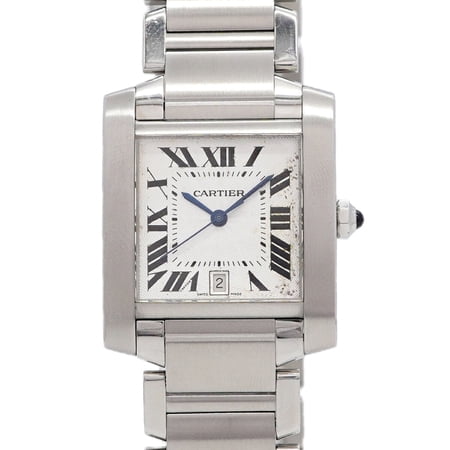
No affiliate products are available for this section, so we have not included specific watches or retailer recommendations. If product cards are retained in the published template, treat them as a prompt for verification rather than a purchase endorsement: confirm the exact Cartier reference and configuration, then check that the warranty and service documentation correspond to that watch. This matters particularly when comparing the Santos and Tank, since collection names alone do not establish the precise case, dial, bracelet, or movement being offered.



Prices and availability are accurate as of the date/time indicated and are subject to change.
Frequently asked questions about Cartier Santos vs Tank
How do the sizes and case dimensions of the Santos compare with common Tank models?
The documented Santos medium measures 35.1mm by 41.9mm, while the large measures 39.8mm by 47.5mm; both are 8.83mm thick. The available evidence does not provide comparable dimensions for Tank Must, Tank Française, Tank Louis, or Panthère models, whose proportions also vary by reference. Compare case length, width, thickness, and lug-to-lug measurements for the specific Tank before buying, rather than relying on the model name alone.
Which movements power Santos models, and how do they compare with movements used in Tank models?
The standard medium and large Santos models use Cartier’s 1847 MC automatic movement, with 23 jewels, a 4 Hz frequency, and a 42-hour power reserve. The movement also uses nickel-phosphorus components and a paramagnetic alloy inside the case. Skeleton Santos models instead use the 9619 MC. The available evidence here does not verify movement specifications for Tank models, so check the exact Tank reference.
How does a titanium Santos wear compared with a steel Santos and with Tank models?
The full-titanium Santos uses a lightweight, mostly matte case and bracelet, and a reported comparison says the large version feels and wears smaller than shiny steel versions. Its bracelet includes QuickSwitch, but the titanium bracelet does not include SmartLink adjustment. The available evidence does not establish comparable weights for Tank models. Choose titanium for a less reflective, more utilitarian feel; choose steel for greater visual presence.
What price information is available for Santos and Tank models in steel, two-tone, precious metal, and skeleton configurations?
The documented Santos prices are historical rather than current: a medium stainless-steel model with bracelet and strap was listed at $6,250, a medium two-tone model at $9,100, and a large 18k rose-gold model at $37,000. The supplied evidence does not verify current price ranges or prices for skeleton Santos or Tank models. Treat these figures as context only and confirm today’s price with Cartier or an authorized retailer.
Which Santos or Tank is better for different wrists, occasions, and preferences?
Choose a Santos when you want Cartier’s sportier, more casual direction, a square case, and a bracelet or strap that can be changed with QuickSwitch. Choose a Tank when a more restrained rectangular character suits formal dressing. The Santos’s medium and large sizes support different wrist proportions, but gender is not a useful dividing line: case dimensions, visual presence, and clothing should guide the choice. Cartier’s Santos heritage reaches back to a watch made for Alberto Santos-Dumont in 1904, with production following around 1911.
Verdict: Which Cartier should you choose?
The most defensible choice in this Cartier Santos vs Tank comparison is the Santos for enthusiasts who want versatility and a more thoroughly documented technical proposition. Its medium and large formats, 1847 MC movement, and interchangeable bracelet system make the size and daily-use decision more concrete, although system availability varies by material.
Collectors have further reasons to look at the Santos: its origin in Louis Cartier’s 1904 watch for Alberto Santos-Dumont, the bracelet introduced in 1978, and skeletonized versions using the 9619 MC create distinct collecting paths. For a formal-watch or gift buyer drawn to Cartier’s rectangular dress identity, the Tank is the more natural concept—but not yet a model-level recommendation. Verify the exact family, size, movement, and current price first.
There is no blanket value winner. Resale performance and servicing economics should be checked against the exact reference and material, rather than inferred from the collection name. The evidence here is stronger for the Santos, so that verdict should remain conditional where Tank documentation is incomplete.