

As an Amazon Associate, we earn from qualifying purchases. We may also earn a commission from other retailers linked on this page, at no extra cost to you.
Franck Muller Casablanca: What It Is and Why It Matters
“Casablanca” describes a watch design lineage, not one fixed specification. Franck Muller launched the original Cintrée Curvex Casablanca in 1998. The name was reportedly inspired by the 1942 film Casablanca. That reference helps explain the model’s identity, but it does not establish a universal case size, movement, or production detail for every watch called Casablanca.
The clearest example is the later Vanguard Casablanca. Its Vanguard case was a major transformation of the Casablanca design, rather than a small change to the original Cintrée Curvex format. The Cintrée Curvex line was also updated in 2022. Taken together, these versions show why “Casablanca” is best understood as a family name spanning different executions and updates.
Specifications must therefore be tied to the correct version. The Vanguard Casablanca is offered in V41 and V43 case-width variations in stainless steel. The V43 variation is available exclusively in Southeast Asia. Its movement is the self-winding caliber MVT FM 800-DT, with a 42-hour power reserve. The listed functions are hours, minutes, central seconds, and date. Those details should not be treated as specifications for every Cintrée Curvex or other Casablanca edition.
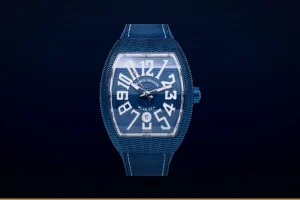
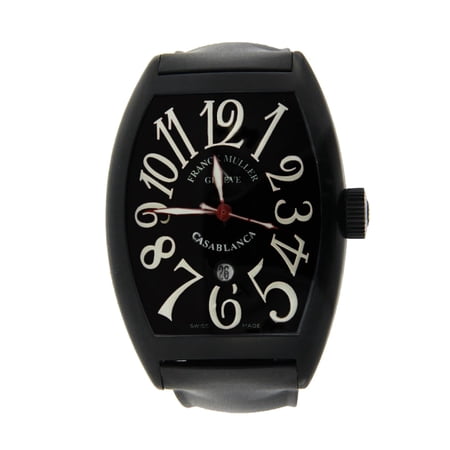
Other details also belong to particular versions. Vanguard examples are listed with black, brown, salmon, and black dials with blue accents. The dials have luminescent Arabic numerals, and the printed numerals are large, radially stretched, and more geometric than those of the 1998 original. The later version also uses more stout skeletonized hands. A listed Vanguard Limited Edition has published case dimensions, material, and water resistance, while its strap is hand-sewn alligator with a hand-polished stainless steel buckle.
For research, begin with the family: Cintrée Curvex, Vanguard, or a named edition such as Casablanca “Osaka.” Then confirm the reference, movement, size, condition, and region. The listed Vanguard references include V 43 SC DT CASA and V41 SC DT CASA. This sequence matters when comparing prices, because watches carrying the same Casablanca name may not share the same case, movement, functions, or market context.
The Short Version: The Casablanca in Plain English
In plain terms, the Franck Muller Casablanca started with the Cintrée Curvex model in 1998 and was updated in 2022. The later Vanguard Casablanca substantially reinterprets the design in stainless steel, with V41 and V43 case-width variations. The V43 is available exclusively in Southeast Asia, so regional availability and provenance deserve careful checking.
Its functions are straightforward: hours, minutes, central seconds, and date. The self-winding MVT FM 800-DT movement provides a 42-hour power reserve. That gives the Vanguard a practical everyday specification, while its case shape and dial design remain central to the collection’s appeal.
For collectors, the important distinction is between standard production variants and market-specific limited editions. The Japanese-market Casablanca “Osaka,” for example, is limited to 10 pieces and measures 36mm high by 31mm wide; differences in rarity and dimensions can materially affect market pricing.
How the Franck Muller Casablanca Works
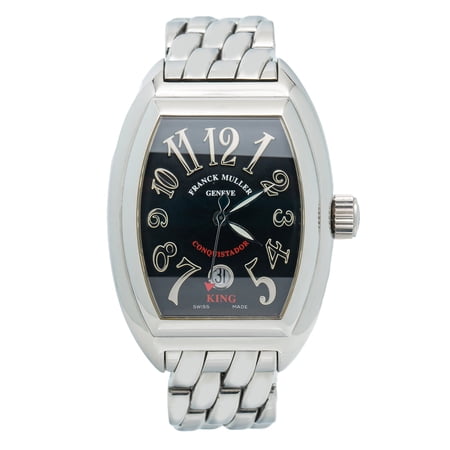
How the Franck Muller Casablanca Works
The name “Casablanca” does not identify one unchanging watch. Franck Muller launched the Cintrée Curvex Casablanca in 1998, while the later Vanguard Casablanca introduced a substantially transformed case. That distinction matters when comparing examples: the collection’s name provides continuity, but the case family and generation provide the more useful starting point.
The Vanguard offers a documented reference point for the modern configuration, but it should not be treated as a universal specification for every Casablanca. Its self-winding MVT FM 800-DT caliber provides hours, minutes, central seconds, and a date, with a stated 42-hour power reserve. The available material indicates that specifications vary across Casablanca configurations, so older Cintrée Curvex examples should not automatically be assigned the Vanguard’s movement details.
Case designation helps separate those configurations. The stainless-steel Vanguard Casablanca is offered in V41 and V43 case-width variations. The listed references are V 43 SC DT CASA and V41 SC DT CASA. The V43 variation is reported as exclusive to Southeast Asia. These labels identify specific Vanguard executions; they do not establish a single case size or construction for every watch carrying the Casablanca name.
The design language also changed with the move to Vanguard. Compared with the 1998 original, the updated watch uses large, bold Arabic numerals that stretch more prominently around the dial and have a more geometric character. The skeletonized hands are described as stouter than those of the original. In practical terms, the dial typography becomes a stronger visual component, while the heavier open-worked hands create a different relationship between legibility and decoration.
Color and lume can narrow the comparison, but neither should be used alone to identify an edition. Documented Vanguard colorways include black, brown, salmon, and black with blue accents. The listed dial options also include luminescent Arabic numerals. A separate limited-edition example has a salmon dial with luminescent indexes and hands. That means a salmon dial is a useful clue, not conclusive identification: a Phillips-listed stainless-steel tonneau-shaped watch is numbered 8 of a 10-piece limited edition.
For a meaningful comparison, read the case, dial, and movement information together. Start with the case family, then check the V41 or V43 designation where applicable, the dial layout and color, the stated caliber and functions, and the accompanying documentation. Recent Vanguard Casablanca pieces use a modernized case and updated dial language while retaining the Casablanca name. The documented evidence supports multiple configurations rather than one complete specification sheet covering the entire line.
Why the Casablanca’s Details Matter to Owners
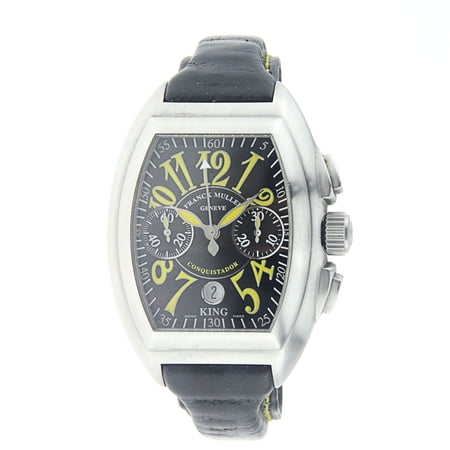
Why the Casablanca’s Details Matter to Owners
A franck muller casablanca is not one fixed specification. Franck Muller launched the Cintrée Curvex Casablanca in 1998. Later examples include the Vanguard, while the Casablanca “Osaka” was made for the Japanese market as a 10-piece limited edition. This history matters when buying. The name alone does not identify the case, movement, dial, bracelet, or strap.
Start with the exact configuration
Check the reference and compare it with the watch offered. The Vanguard Casablanca is available in stainless steel with V41 and V43 case-width variations. The V43 version is described as exclusive to Southeast Asia. Its self-winding MVT FM 800-DT movement has a 42-hour power reserve and displays the hours, minutes, central seconds, and date. The listed dial choices are black, brown, salmon, and black with blue accents. They use luminescent Arabic numerals. The supplied strap is hand-sewn alligator, paired with a hand-polished stainless-steel buckle.
These details give a buyer practical checks. A listing for a Vanguard should match the stated case variation, regional description, dial, movement, and strap. A photograph of a similar Casablanca is not enough. The available information does not establish one universal size, movement, or configuration for the original Cintrée Curvex family.
The Casablanca “Osaka” requires a different comparison. It is a stainless-steel, tonneau-shaped watch with a salmon dial, center seconds, and a number eight marking within a 10-piece edition. Its dimensions are 36 mm in height by 31 mm in width. The dial has luminescent indexes and hands. “Osaka” and the case number “8” appear on the caseback and on the dial above 6 o’clock. The case, dial, and movement are signed, and the watch is fitted with an unsigned stainless-steel pin buckle. For this model, those markings and parts are useful points of comparison when checking identity and completeness.
The circa-2000 Reference 7502 S6 is different again. Sotheby’s describes it as a stainless-steel wristwatch with a mechanical, jewelled caliber. It is supplied with an unsigned stainless-steel bracelet and a double folding clasp. The listed dimensions are 38.5 mm in length by 28 mm in width, with an approximate bracelet circumference of 140 mm. Its documented case number is 1’219. These measurements may help assess a specific example, but they should not be applied to every Casablanca.
| Example | Documented points | Buying checks |
|---|---|---|
| Original Cintrée Curvex Casablanca | Launched in 1998 | Specific size, movement, and configuration are not established here |
| Vanguard Casablanca | Stainless-steel V41 and V43 case-width variations; self-winding MVT FM 800-DT; 42-hour power reserve | Confirm the stated width and regional version. V43 is described as exclusive to Southeast Asia |
| Casablanca “Osaka” | 36 mm high by 31 mm wide; salmon dial; luminescent indexes and hands; 10-piece Japanese-market edition | Compare the edition number, Osaka markings, signatures, and buckle with the offered watch |
| Reference 7502 S6 | Circa 2000; 38.5 mm by 28 mm; stainless-steel case; unsigned bracelet | Accuracy, component originality, and service condition are not assured |
Condition is part of the specification
Service history can change the buying decision. In Sotheby’s documentation for the Reference 7502 S6, the movement had not been tested for accuracy and might require servicing at the buyer’s expense. Sotheby’s also did not guarantee future operation or the authenticity of individual component parts. It noted that parts may have been replaced during repairs or restoration. This is why a signed case, dial, or movement should be treated as one checkpoint, not as a substitute for examining the movement, case, and accessories. Service records, if available, belong in the valuation and negotiation process.
Read auction prices with care
Published auction figures describe particular watches. They are not a universal price guide for the Casablanca family. The documented Reference 7502 S6 carried an estimate of HK$20,000–40,000. The documented Osaka example sold for HK$20,320. These figures concern different references and configurations. Market-specific limited editions can affect rarity and pricing. A buyer should therefore compare edition, condition, completeness, and servicing uncertainty before using either figure as a reference for another watch.
Common Misconceptions About the Franck Muller Casablanca
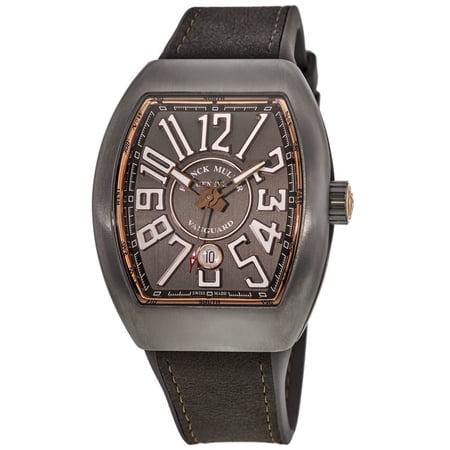
Common Misconceptions About the Franck Muller Casablanca
The name “Casablanca” does not point to one unchanging specification. It describes a design lineage that began with the Cintrée Curvex Casablanca, launched in 1998, was updated in 2022, and later included a Vanguard reinterpretation. The name is also associated with inspiration from the 1942 film Casablanca. That history is why a listing that identifies only the collection name does not, by itself, establish the watch’s case, movement, functions, or production context.
The Vanguard Casablanca should not be treated as the original model with a new dial. The Vanguard case is described as a major transformation of the Casablanca design. Stainless-steel versions are offered in V41 and V43 case widths, with the V43 variation available exclusively in Southeast Asia. The documented Vanguard configuration uses the self-winding MVT FM 800-DT, has a 42-hour power reserve, and provides hours, minutes, central seconds, and a date. Those details belong to the documented Vanguard configuration and should not automatically be assigned to an earlier Cintrée Curvex or to another Casablanca variant.
Visual details can also help distinguish generations, but they should not replace reference information. The Vanguard’s printed hour numerals are described as larger, more radically stretched, and more geometric than those of the 1998 original, while its skeletonized hands are more substantial. The Vanguard is also documented with black, brown, salmon, and black-and-blue dial options, luminescent Arabic numerals, a hand-sewn alligator strap, and a hand-polished stainless-steel buckle. The listed references are V 43 SC DT CASA and V41 SC DT CASA. A photograph or seller description that uses “Vanguard” without confirming the reference still leaves room for confusion.
“Casablanca” does not mean standard production. The Osaka is identified as a Franck Muller Casablanca model and is described as a stainless-steel, tonneau-shaped wristwatch with center seconds and a salmon dial. It is numbered 8 from a limited edition of 10 pieces, made for the Japanese market; “Osaka” and the case number appear on both the caseback and the dial above 6 o’clock. Phillips dates the watch to circa the 2000s. This example shows why a market designation, edition size, case number, and exact configuration matter when comparing listings.
An auction estimate is not a definitive value or a mechanical guarantee. Sotheby’s lists a Casablanca Reference 7502 S6 as a stainless-steel wristwatch with bracelet, dated circa 2000, with an estimate of 20,000 to 40,000 HKD. The same listing states that the movement was not tested for accuracy and may require servicing at the buyer’s expense. Sotheby’s also does not guarantee the movement’s future operation or the authenticity of individual components, which may have been replaced during repair or restoration. The estimate should therefore be read as the auction house’s estimate for that lot, not as a universal value for every Casablanca.
Search terms such as “5850,” “2852,” “gold,” or “chronograph” are useful starting points, but the collection name alone does not verify any of them. Confirm the exact reference, case material, functions, movement, edition information, and supporting documentation before treating a seller’s description as established fact. The available examples show that Casablanca watches can belong to different design updates and can include market-specific limited editions, with those distinctions affecting rarity and pricing.
Frequently Asked Questions
What is the origin and history of the Franck Muller Casablanca line?
The Casablanca began as a Cintrée Curvex model launched in 1998. Franck Muller was reportedly inspired by the 1942 film Casablanca, while the brand presents the watch as a classic expressing 20th-century, sober refinement. The line is best understood as a design lineage rather than one fixed reference: the Cintrée Curvex was updated in 2022, followed by a substantially reinterpreted Vanguard version.
How does the Vanguard Casablanca differ from the 1998 Cintrée Curvex Casablanca?
The Vanguard Casablanca changes the case architecture and dial language rather than simply repeating the original. It uses the Vanguard case in stainless steel, with V41 and V43 width variations, while the numerals are larger, more radically stretched and more geometric. The hands are also more substantial and skeletonized than those of the 1998 original. The documented colorways are black, brown, salmon, and black with blue accents.
What movement and functions are used in Vanguard Casablanca models?
The documented Vanguard Casablanca uses Franck Muller’s self-winding MVT FM 800-DT caliber, with a stated 42-hour power reserve. Its listed functions are hours, minutes, central seconds, and date. These details apply to the Vanguard Casablanca specification cited here; they should not automatically be assigned to every earlier or special-edition Casablanca, since the name covers multiple case families and configurations.
What do the V41 and V43 Casablanca references mean?
V41 and V43 identify the documented Vanguard Casablanca case-width variations, both in stainless steel. The available source does not provide a general decoding system beyond those width designations, so buyers should not assume that the numbers describe movement, complication, or material. The V43 variation is documented as exclusive to Southeast Asia, while the listed references include V 43 SC DT CASA and V41 SC DT CASA.
What is the Casablanca “Osaka,” and why is it notable?
The Casablanca “Osaka” is a circa-2000s, limited-edition stainless steel tonneau-shaped watch made for the Japanese market. Phillips documents a salmon dial, center seconds, luminescent indexes and hands, and a 36 mm height by 31 mm width. The edition is limited to 10 pieces; the cited example is number 8, with “Osaka” and its case number appearing on the dial and caseback.
What should buyers check when purchasing a pre-owned Franck Muller Casablanca?
First identify the case family, reference, dimensions, material, functions, and any market-specific or limited-edition designation; “Casablanca” alone does not establish a gold case, chronograph, or one movement. Then compare the signed case, dial, and movement with the seller’s description, and inspect the bracelet, buckle or strap. Auction documentation also warns that accuracy, future operation, authenticity of replaced components, and servicing may require independent verification.
Key Takeaways: How to Understand the Casablanca
Key Takeaways: How to Understand the Casablanca
Start with the family, not the reference number. Franck Muller launched the Cintrée Curvex Casablanca in 1998. The collection later received a Vanguard reinterpretation, so “Casablanca” describes a design lineage rather than one fixed specification.
- Identify the case family. Decide whether the watch belongs to the original Cintrée Curvex line or the later Vanguard version. The Vanguard Casablanca is offered in stainless steel and in V41 and V43 case-width variations. The V43 version is available exclusively in Southeast Asia, according to the cited product information.
- Read the exact reference. A reference identifies the documented example; it does not establish that every watch in the collection has the same dimensions, materials, movement, dial, or water resistance. Sotheby’s, for example, describes reference 7502 S6 as a stainless steel Casablanca with a bracelet, dated circa 2000.
- Check the individual specification. Some Vanguard Casablanca versions use the self-winding caliber MVT FM 800-DT, with a 42-hour power reserve and hours, minutes, central seconds, and date. Those details belong to the documented version and should not be applied to every Casablanca without supporting information.
- Assess the dial and materials. Documented examples can differ significantly. The Vanguard Casablanca is listed with black, brown, salmon, and black-and-blue dial options. A separate limited edition is described as a stainless steel tonneau-shaped watch with a salmon dial, center seconds, and number 8 of 10 pieces.
- Treat auction records as context. Auction listings show the range of examples collectors encounter, including limited editions associated with particular markets. They are not automatic valuations. An estimate of 20,000 to 40,000 HKD applies to the cited Sotheby’s lot, not to the entire Casablanca line.
- Examine originality and condition. Look for consistency between the case, dial, and movement, then seek credible provenance and an independent assessment of movement condition. Some examples have signed case, dial, and movement components, but signatures alone do not settle originality or service history. Sotheby’s also states that it cannot guarantee future movement performance or the authenticity of individual parts that may have been replaced during repair or restoration.
The practical order is clear: identify the family, verify the reference, confirm the specification, and then assess condition and provenance. The name establishes the starting point. The individual watch determines what can reasonably be concluded.